
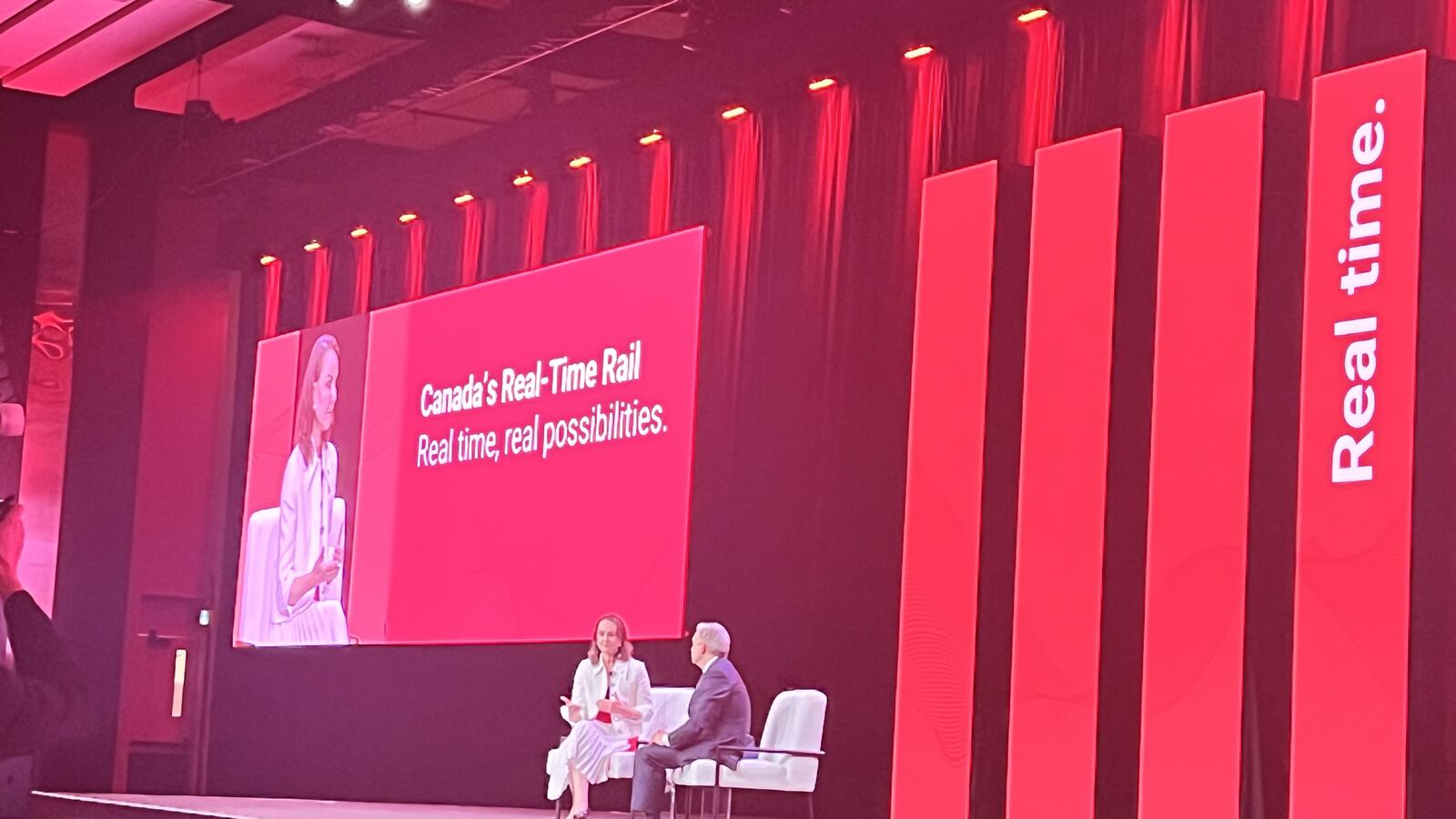
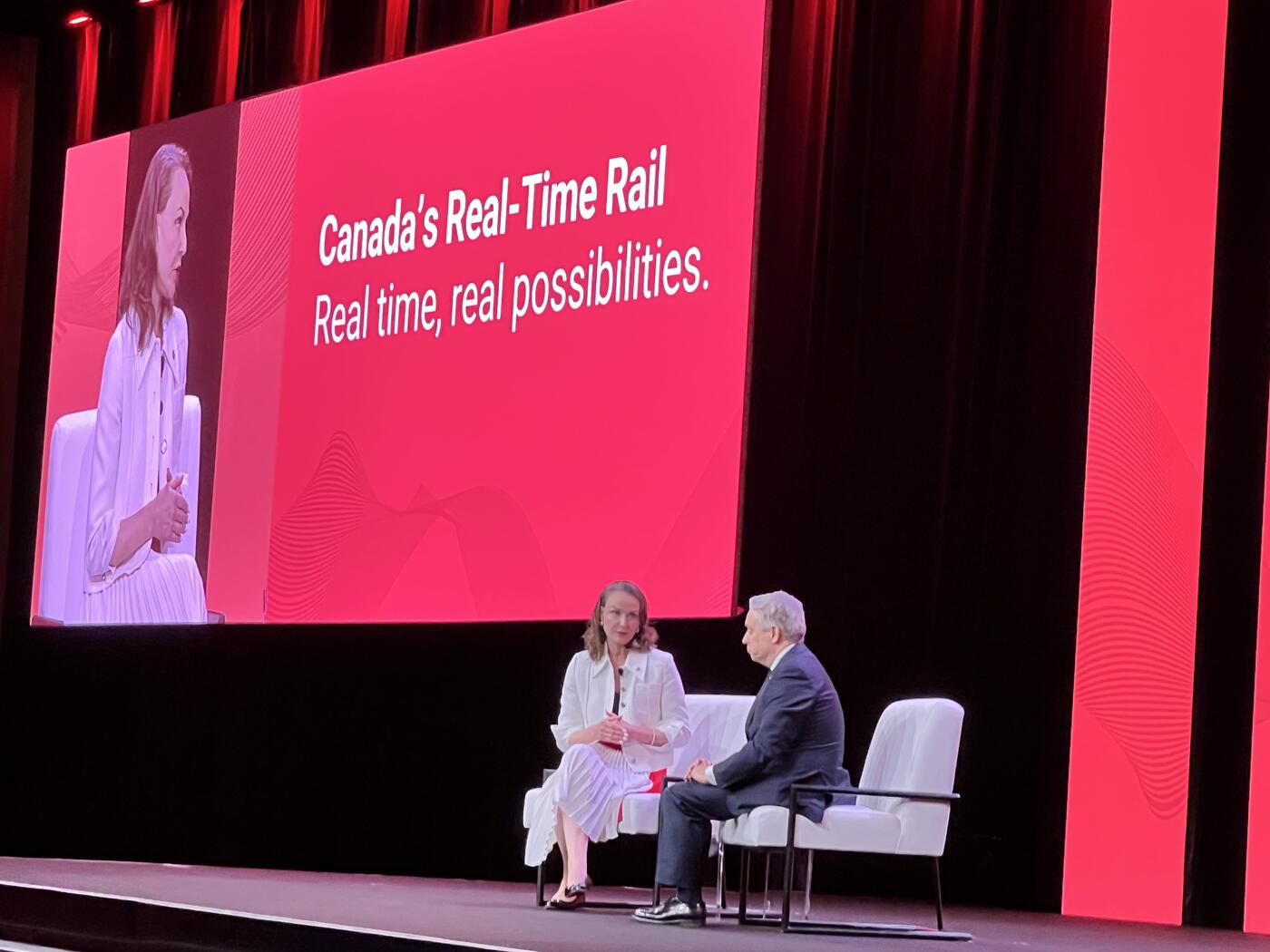
The Payments Canada Summit brought together policymakers, financial institutions, fintech leaders, regulators, payment innovators, and technology companies at a moment of significant transformation across the global financial ecosystem. One of the most closely watched conversations of the Summit was the closing fireside chat with The Honourable François-Philippe Champagne, Minister of Finance and National Revenue, whose remarks connected payments modernization with broader themes — innovation leadership, economic security, digital sovereignty, financial crime, talent, affordability, and Canada's global competitiveness.
Setting the Stage
The Summit's discussions focused on payments modernization, digital infrastructure, artificial intelligence, cybersecurity, financial resilience, and Canada's role in the evolving digital economy. The moderator framed the moment squarely:
"We are in a period of transformation where the choices we make now will shape the everyday lives of Canadians and Canada's competitiveness as well. We have a real opportunity to drive economic growth for years to come."
The remarks pointed to the federal government's recently released Spring Economic Update as evidence of Ottawa's priorities in the current environment, anchored around "safety, security, productivity, and growth."
Minister Champagne's background was described as uniquely combining international business experience with public service leadership. Before entering politics, he spent over two decades as an executive and legal counsel for major international organizations — an experience that helped shape his reputation as "pragmatic and outcome-driven." Since entering federal politics in 2015, he has held senior cabinet roles spanning international trade, foreign affairs, infrastructure and communities, and innovation, science and industry. The moderator connected his recent policy work directly to the themes of the Summit: the federal budget, the economic update, and Canada's national anti-fraud strategy.
The discussion reflected a clear message throughout the Summit: Canada has the talent, institutional strength, research capability, and innovation ecosystem to become a global leader in digital finance and responsible innovation — but future success will depend on modernization, resilience, commercialization, and a stronger sense of national ambition.
Canada's Opportunity in the Digital Economy
Champagne opened by highlighting the strong international participation at the Summit and the growing global interest in Canada's payments and innovation ecosystem.
"Canada, I think, can lead the world. We are a trusted partner."
To the international guests in the room, he added:
"I think Canada is the buzzword these days, I can tell you. At the G7 and the G20 and where we go, people are excited. There's something about Canada that certainly inspires."
Trust, he repeatedly emphasized, is the foundation for innovation:
"If people in the street, if we take a walk, and they trust the system, they trust the payment system, they trust the intermediaries in that, they will adopt the technology. And adoption will lead to innovation."
The discussion reinforced that trust is becoming increasingly important as countries and organizations modernize payment systems, adopt AI, and deploy critical digital infrastructure. Reliability, governance, operational security, and resilience are now central to long-term adoption.
Champagne also called for a stronger national mindset around ambition and innovation leadership.
"How can I inspire a higher level of ambition? For too long, we've been, in a way, so Canadian. We need to brag a bit more."
He framed Canada's future in terms of "ambition with confidence, with vision," arguing that the country already possesses many of the ingredients necessary for global leadership in fintech, AI, digital infrastructure, and next-generation technologies.
A World Defined by Volatility
Asked to describe the "North Star" guiding the government's focus, Champagne began by framing the moment as one of historic transformation.
"Great that we'll be building at a speed and scale not seen in a generation. And obviously, this includes our payment system."
He acknowledged that many people are experiencing unease about the pace of global change.
"It's the speed, scope and scale of change."
He pointed to multiple overlapping pressures shaping the global environment — from geopolitics and supply chains to artificial intelligence and cybersecurity — describing a growing public feeling that events are moving beyond people's control.
"If you and I were to go out on the street, probably people would say the wind is blowing quite hard. There's a sense of loss of control in what's happening in the world."
Reflecting on his experience chairing G7 finance ministers during Canada's 2025 presidency:
"I used to say we need to make sure that uncertainty does not become the new certainty."
"Fast forward to 2026, it's really the level of volatility and complexity that we're seeing, which is quite unprecedented."
He referenced tariffs, technological disruption, and Middle East conflict, raising concerns about food security and fertilizer supply chains, before connecting back to Canada's role:
"If you ask me the North Star, we are seen as a country which provides unparalleled opportunity, a very predictable partner, and I would even say a partner of choice."
Domestic Priorities: Fiscal Discipline, Affordability, Resilience
Champagne argued that recent fiscal results were important not only economically, but symbolically.
"I think the fact that we delivered on that and show that we have a lower deficit than we projected, I think is giving confidence to people that this is a serious moment, and that there are serious people in the government to make sure that we do the right thing."
He pivoted to affordability:
"If you and I and all of us were walking in the street, there are three things people talk about — housing and affordable homes and the cost of rent. They would talk about the food trucks, and they would talk, obviously, about the price of gas."
"Affordability is probably the biggest challenge we find in all the G7 nations. Canada is not immune to that."
He shared specific allocations:
"We had about $7 billion of additional revenues, and two-thirds of that went back to support people with the grocery benefit, with the housing that we agreed with the province of Ontario."
Champagne then turned to Canada's relative G7 performance:
"Canada is gonna have the second fastest growth in the G7, just after the United States."
"We're growing twice as much as Germany. We're growing twice as much as the UK. We're growing faster than France. We're twice as much as Japan and three times more than Italy."
He highlighted Canada's fiscal standing, citing the IMF:
"They single out Canada and Germany because we're the only two G7 nations with a triple-A credit rating."
"She was saying if you're smart enough to use your fiscal power to invest in housing, infrastructure, innovation, and productivity, you're going to get ahead. Well, look, that's exactly what we're doing in Budget 2025."
He pushed back against the narrative that Canada's outperformance is solely about oil:
"I've heard some government bankers say this is all about the oil price. No. This is more about the size and the resiliency of Canada and Canadian workers."
He linked payments innovation directly to international ambition:
"You want to connect Canada to the world and the world to Canada."
Payments Modernization and the Real-Time Rail
A major focus of the Summit was Canada's ongoing payments modernization journey and the broader role payment systems will play in the future economy. Champagne placed the Real-Time Rail (RTR) at the centre of that vision.
"We really need to modernize how we facilitate payments. It's cross-border, it's B2B, B2C."
Throughout the Summit, payment infrastructure was no longer treated simply as a banking utility. It was discussed as foundational national digital infrastructure supporting commerce, innovation, operational efficiency, financial inclusion, and economic resilience.
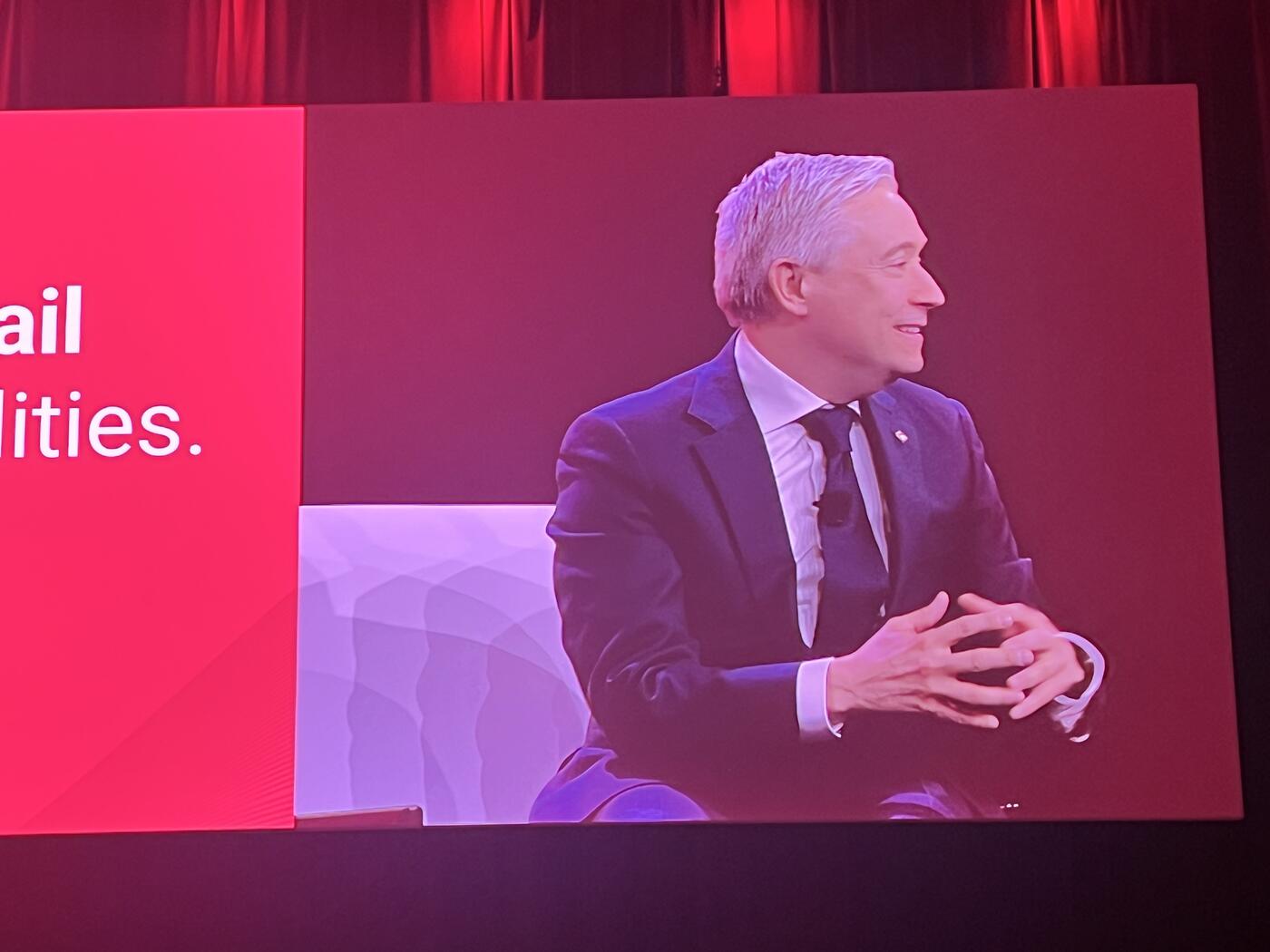
The moderator quoted directly from the government's economic statement, describing the Real-Time Rail as "a cornerstone of our modernization agenda that will serve as a powerful engine for national productivity and economic growth," and as "a catalyst for competition, empowering a more dynamic and inclusive financial sector."
Champagne's response sharpened the point:
"This is the best work, because I think beyond the work is the intent and the vision."
"You are really the ones who are going to make that real. You can put it in a statement, but I need each and every one of you in that journey of leadership, that journey of innovation, that journey of trust."
Discussions across multiple sessions of the Summit reinforced how modern payment infrastructure can enable faster commerce, reduce transaction friction, improve business efficiency, support fintech innovation, and enable new digital business models — while also strengthening the connection between payments infrastructure and economic resilience.
Global Learning and Canadian Innovation
The fireside discussion emphasized the importance of learning from international best practices while continuing to strengthen domestic innovation capabilities. Champagne referenced India's rapid advancement in real-time payments and digital transaction ecosystems.
"I just came from India. I see solutions on the floor to facilitate payments. And I think this is a good thing."
He cited Estonia and India as nations that "leapfrogged" technology through payments modernization, and argued that Canada has the opportunity to build globally competitive solutions from within its own ecosystem.
"As Canadians, we're lucky because whenever people look at products coming from Canada, just because it's Canada, there's an element of trust."
"There's an element of trust that we should really nurture as Canadians. People will trust intrinsically Canadian solutions and Canadian innovators."
The discussion repeatedly highlighted Canada's strengths in universities and research institutions, technical talent, artificial intelligence, quantum technologies, fintech innovation, and digital infrastructure.
Open Banking, Stablecoins, and Competition
"It's key for innovation and better services, better prices. I think Canadians are craving for more competition in different sectors."
He named specific initiatives:
"Certainly open banking is one of them. We've passed, we're going to drop down the regulation around stablecoins."
"We want to be best in class. We want Canadians to adopt Canadian solutions."
The framing positioned competition policy, open banking, and stablecoin regulation as connected levers in a single agenda: giving Canadians more choice while strengthening domestic innovation.
Canada as an "Innovation Superpower"
Champagne reframed Canada's traditional economic identity in striking terms:
"We talked about the energy superpower, about a food producing country, but I think we're also an innovation superpower."
"We're at the forefront of AI. We were the first AI national strategy. We have the first quantum strategy."
AI, quantum technologies, cybersecurity, software, fintech, and digital infrastructure were repeatedly identified across the Summit as strategic growth areas for Canada. Participants emphasized that future competitiveness will depend not only on generating innovation, but on retaining talent, scaling Canadian companies, commercializing intellectual property, building resilient infrastructure, and competing globally.
The discussion acknowledged concerns about Canadian innovation and talent moving to foreign markets, particularly the United States, while reinforcing that Canada possesses deep technical capability and research leadership.
He also floated the idea of a digital trade mission:
"We often do these trade missions, which is more on the product side. But what about digital services that we can bring to the world?"
And proposed expanding the Payments Canada Summit itself:
"I really want to bring the world to the payment summit. We should think about how we can really make sure that next time… bringing G7 partners around that and really talk about the opportunity and challenges we have in front of us — making the Payments Canada Summit kind of like the reference point when you're looking at the future."
Financial Crime and Cybersecurity
One of the most consequential threads of the conversation focused on financial crime, cybersecurity, fraud, and the new instruments of enforcement.
"I just want to bring you behind the scenes. When we were chairing the G7, and I brought that, because for me, this is one of the biggest challenges we're seeing not only in our country, because we're not immune."
"There's a transnational nature to that. You may have seen the work out of the extortion, for example. And all that is connected."
"The extortion of seniors being scammed, that's why we need to double down, because I'm really concerned."
"For me, it's economic security, but it also transcends national security."

Champagne then made a significant policy announcement: the creation of a dedicated Financial Crime Agency.
"That's why we're creating the Financial Crime Agency. So we'll have our own version of a serious fraud office for money laundering."
He described what kind of agency it must be:
"We need the best brain in policing of the 21st century. So it's not just people with badges. It's people with computers and people who understand the interaction, especially when you think about quantum and AI in the cyber world."
He referenced direct briefings with US partners:
"We had a discussion with Treasury, the FBI, and the Secret Service recently. The next frontier of that is very complex."
"The best way to catch these people is to find the intelligence. You go with intelligence and then you need models. You need smart people."
He confirmed an upcoming policy action targeted at a specific vulnerability:
"We've seen that we're going to be banning crypto ATM."
He drew a clear line between legitimate and illicit use of digital assets:
"The others who are in the field, which provide legitimate services, there's no issue whatsoever. What I'm concerned is this becoming a vector for financing terrorism and other things."
He referenced reporting in the Toronto Star as a source of his concern, and made a direct ask of the audience:
"All of you who have solutions, expertise, excellence to share, should. Because the more we build trust, the better we're all going to be."
"I want to be best in class, actually. Next time I go to a meeting at the G7, I don't want to be lectured. I want to do the lecturing."
The session also highlighted concerns around fraud prevention and protecting vulnerable Canadians from increasingly sophisticated scams — and the kind of expertise required to keep up: artificial intelligence, cybersecurity, quantum technologies, cryptology, cross-border intelligence, digital fraud, and forensic accounting.
Economic Security, Sovereignty and Resilience
A further major theme was the growing relationship between economic security, national security, and critical infrastructure. Modernization efforts touching the Bank Act and financial oversight frameworks were framed in the same register. Rather than reducing the issue to ownership or foreign participation, Champagne repeatedly emphasized resiliency as the central objective — touching critical infrastructure resiliency, banking system security, cloud infrastructure, telecommunications, payment rails, and digital sovereignty. The discussion reflected a broader shift visible across the G7 and OECD: the recognition that payments rails, financial systems and cloud infrastructure are now strategic national assets.
This thread reinforced that payments modernization, cybersecurity, innovation policy, digital infrastructure, and economic resilience are increasingly interconnected components of national competitiveness — and that there are significant opportunities for technology providers operating across payments, cybersecurity, AI, cloud infrastructure, fraud prevention, compliance, digital identity, quantum security, and financial infrastructure modernization.
As Canada accelerates investments in real-time payments, economic resilience, financial crime prevention, and digital sovereignty, there is growing demand for solutions that can support secure, scalable, and resilient national infrastructure: AI-driven fraud detection, cyber resilience, cloud security, payment orchestration, regulatory technology, digital trust frameworks, quantum-safe security, and cross-border payment innovation. The conversations also reinforced that Canada is increasingly looking for technology partners that can combine innovation with trust, governance, operational resilience, and long-term ecosystem collaboration.
Closing: Ambition, Confidence, Vision

Closing the conversation on an emotional and optimistic note, Champagne delivered a final message centred on ambition, confidence, and national purpose.
"We need to practice more. That's kind of what I'm saying in a way, you know, ambition with confidence, with vision."
"That really would be these three words."
"We have so much to offer to the world at the critical point in world history that the world is craving for Canada."
"We lead with the strength of our values. We lead with the strength of our innovation. We lead with the strength of our people."
"When I'm in a group like that, you have to feel inspired."
"With your leadership and the leadership of the people I see in this room, I see no challenge too big for us as a nation."
He framed Canada itself as "a lighthouse in many ways," and added:
"I've never been more confident in the future of Canada. And it starts with each and every one of you."
The Minister concluded with a direct call to unity and action:
"So let's seize the moment. Let's be ambitious. Let's build Canada strong together."
Session Highlights
- "Canada, I think, can lead the world. We are a trusted partner." Trust positioned as Canada's strongest advantage in the future digital economy.
- North Star: Canada as a country of "unparalleled opportunity, a predictable partner, a partner of choice."
- "Uncertainty must not become the new certainty" — but the volatility and complexity of 2026 is unprecedented.
- $7 billion in additional revenues, with two-thirds redirected to affordability (grocery benefit, Ontario housing agreement).
- Canada to be the second-fastest growing G7 economy, after the United States — growing twice as fast as Germany, the UK and Japan, and three times faster than Italy.
- Triple-A credit rating — Canada and Germany are the only two G7 nations to retain it, according to the IMF.
- Payments modernization is now a national competitiveness issue: payment systems are increasingly treated as critical national digital infrastructure.
- Strong focus on modernizing cross-border, B2B and B2C payments.
- Canada's Real-Time Rail described as "a cornerstone of our modernization agenda" and a catalyst for competition and a more dynamic, inclusive financial sector.
- India and Estonia referenced as global benchmarks for "leapfrogging" through payments modernization.
- New Financial Crime Agency announced — Canada's "serious fraud office" for money laundering and 21st-century cyber-enabled crime.
- Financial crime reframed as "policing of the 21st century" — AI, cybercrime, quantum technologies, and digital fraud reshaping enforcement.
- Specialized talent — AI, cryptology, cybersecurity, forensic accounting — identified as critical for Canada's future financial-crime capabilities.
- Crypto ATMs will be banned — but legitimate digital asset providers are unaffected.
- Open banking and stablecoin regulation incoming.
- Canada repositioned as an "innovation superpower" — citing the first national AI strategy and the first national quantum strategy.
- Economic security and national security described as increasingly interconnected — banking systems, payment rails, cloud infrastructure and telecommunications now treated as strategic assets.
- "There is a premium on resiliency these days" — resilience emerges as the defining priority across financial and digital infrastructure systems.
- Champagne proposes a digital trade mission and expanding the Payments Canada Summit into a G7-level global forum.
- Closing words: ambition, confidence, vision — and "Let's build Canada strong together."
Sarzamin Magazine Editor's Perspective
Editorial commentary — separated for review and correction. Not part of the reported transcript.
Minister Champagne's closing address was, in our reading, the most strategically loaded fireside of the Summit. Stripped of its rhetoric, the speech functioned as a sequencing exercise: fiscal credibility first, affordability second, then resilience, then payments and innovation, and finally enforcement. That ordering is itself a signal — Ottawa is asking Canadians to accept that competitiveness, payments modernization and financial-crime enforcement are now a single policy file, not three.
Three points stood out to us.
First, the Minister's framing of trust as a strategic export is not just political language. With only Canada and Germany retaining a triple-A IMF assessment among the G7, and Canada projected to be the second-fastest-growing G7 economy after the United States, the country has — for the first time in a decade — the macro-credibility to brand itself as a trusted operator of digital and financial infrastructure. The challenge is that this advantage compounds only if Canadian institutions move quickly to commercialise it; trust without speed atrophies.
Second, the announcements on the Financial Crime Agency and the crypto ATM ban were the most concrete deliverables of the session. The Minister's insistence that the new agency be staffed with "people with computers" as much as "people with badges" is the right instinct, but the difficult question — how Canada will recruit and retain AI, cryptology and forensic-accounting talent against US-scale compensation — was not answered. This is the gap the industry should be pressing on.
Third, the Minister's vision of an expanded, G7-anchored Payments Canada Summit, combined with a proposed digital trade mission, hints at a deliberate attempt to convert Canada's payments modernisation into soft-power infrastructure — echoing the way countries such as India and Estonia (both cited by the Minister) used domestic real-time payments to project influence abroad. If Ottawa is serious about that ambition, the Real-Time Rail, open banking, and stablecoin regulation cannot be treated as separate workstreams. They are now, in effect, instruments of foreign and economic policy.
Our takeaway: Canada has rarely had this combination of macro-stability, technical depth and policy clarity at the same time. The Minister's call to "brag a bit more" is, in our view, the right reading of the moment. The risk is not over-ambition. It is, as it has been before, under-execution.
— Sarzamin Magazine Editorial Desk
Posted in Digital Transformation · Government · Payments